Corporations are not your friends

As a kid, I’d do just about anything to get mail – apply for rebates as small as a dollar, request tourism brochures from Canada, clip UPC symbols from cereal boxes for Matchbox cars. So back when 3M was first trying to get the world hooked on Post-It notes, I sent away for the free samples, meaning that, at the age of twelve, I got to be among the first humans to marvel at those little yellow squares.
The Twin Cities may have been hundreds of miles from my childhood home in Wisconsin, but my kid-self was well on the way to believing that Minnesota’s corporations were forces for good in the world. 3M was friendly and innovative. General Mills made the mixes for our birthday cakes and helped our school through “Boxtops for Education.” Our nearest Target store was a clean and affordable wonderland.
A few years after college, I moved to Minneapolis to work for a family-owned newspaper with a pay scale in the top ten nationally, and I learned that many Minnesota companies were ranked as good employers and leaders in philanthropy.
American corporations work so hard to get us to think of them as friends. And relationship-starved Americans want to view them that way.
But friends sometimes let friends down, and imaginary friends that are in fact impersonal, profit-focused corporations can let us down in spectacular fashion.
Less than four years after I arrived in Minneapolis, the benevolent family that owned the newspaper sold it to an out-of-town chain, and decades of diminishment followed. 3M is now almost as famous for contaminating drinking water as it is for Post-It notes. General Mills pumps out highly processed, sugar-laden foods to an unhealthy populace. Target, after tossing away its diversity efforts to appease a would-be dictator, is calling the police on shoppers who sing in its stores while allowing ICE to abduct its employees.
And the largest corporation in Minnesota, UnitedHealth, makes billions primarily by taking in more in premiums than it pays out in care. Because private health insurance is a scheme that leads to sickness, bankruptcy, and tens of thousands of deaths each year.
Some friends.
In Minnesota, historically, we’ve had reasonable reasons to “expect more” (to quote Target’s slogan) from our corporations as civic institutions. But both world history and current events have shown us how quickly companies will say yes to authoritarian leaders and find ways to enrich themselves from systems of brutality.
German corporations that are still around, such as Continental (known for its tires), Volkswagen, and Bayer, made good money working with Nazis. Today in the United States, airlines and private prison companies are profiting off ICE abductions and detention centers. And Target was one of the companies to cozy up to the president by donating a million dollars to his inauguration committee.
Some friends.
Apple, which is forever trying to be everyone’s coolest friend, also gave a million dollars to the inauguration. It’s used to working under dictatorships – most of the 1.5 million employees in its supply chain are in China, one of the least-free countries in the world. Closer to home – my home – Apple’s been a fickle neighbor. It opened one of its stores a few blocks from an independent Apple dealer, which then went out of business. Then Apple closed, too, and its former store became a derelict collage of graffiti.
Some friends.
Don’t get me wrong – my MacBook and iPhone and iPad serve me well, and before the boycott, I was a lifelong Target regular. I’m not immune to having positive feelings toward large retailers, brands, and corporations. But, unlike when I was a kid, I try to think of them the way they think of us: not as friends, but as means to an end.
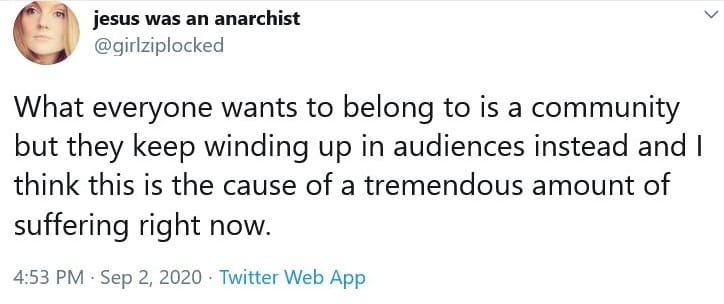
People want a sense of belonging, they want their needs met, they want to feel special, and corporations are happy to oblige with transactional versions of these things. But a customer is at most an audience member, one whose status relies on ongoing payment. See how long your sense of belonging lasts at Target or an Apple store or a pro sports game (also corporations, heavily subsidized ones) without handing over money. Those with means can keep up the illusions of commercialized "relationships." Those without means feel excluded from participating in what has become a primary American identity: consumer.
I'm lucky to live in a place with alternatives – I can work for a nonprofit employer, work out at a nonprofit gym, shop at a nonprofit grocery co-op, bank at a nonprofit credit union, and play my fiddle at a nonprofit music school. None of these places exist to extract money from me and transfer it to wealthy shareholders; they exist for a completely different set of values.
And smaller for-profit businesses – like the independent bookseller just down the block from the defunct Apple store, or the bakery where I get my bread – are connected by accountable relationships, and sometimes even actual personal friendships, to the community. (I get that there's privilege of these options. For a lot of Americans, the shopping choices are Walmart, Amazon, or another thirty minutes of driving.)
So in these times, I've tried my best to adjust my mindset about corporations, and adjust my practices. I'm still avoiding Target and have protested at its flagship store, and I'm buying local when I can.
Over the first few months of this year, we in Minnesota had a front-row seat to who's going to be on the side of goodness in a crisis, and our biggest companies turned out to be wishy-washy disappointments.
It was the everyday people, turning out and giving money again and again, who showed us who our friends really are.